

Reading Private-Investment Updates: What Changed, What Is Missing and What Needs Review
A quarterly report is useful only after the office matches it to the right entity and period, compares the right facts, and separates a missing record from a negative event.
How should a family office review private-investment updates?
Review a private-investment update in three passes: confirm the entity and reporting period, compare changed facts against the prior update and governing records, then identify missing documents or statements that need follow-up. AI can assemble and cite the evidence, but people should make financial, legal, tax, and investment decisions.
The Hard Part Is Matching Before Comparing
Private-investment updates arrive as quarterly letters, financial statements, capital-account statements, notices, spreadsheets, emails, and portal files. A polished comparison is still wrong if it pairs two different entities, funds, share classes, currencies, or reporting dates.
Start with identity. Normalize the manager name, fund or company, investor entity, vehicle, period end, document type, and version. Keep the original file and record the match logic. Similar filenames are not sufficient evidence.
This process supports earlier visibility into records that need attention. It does not promise to prevent investment loss, forecast trades, or replace portfolio analytics. Sovereign Layer’s approach connects an indexed private archive with collection, review and briefing routines scoped to the office.
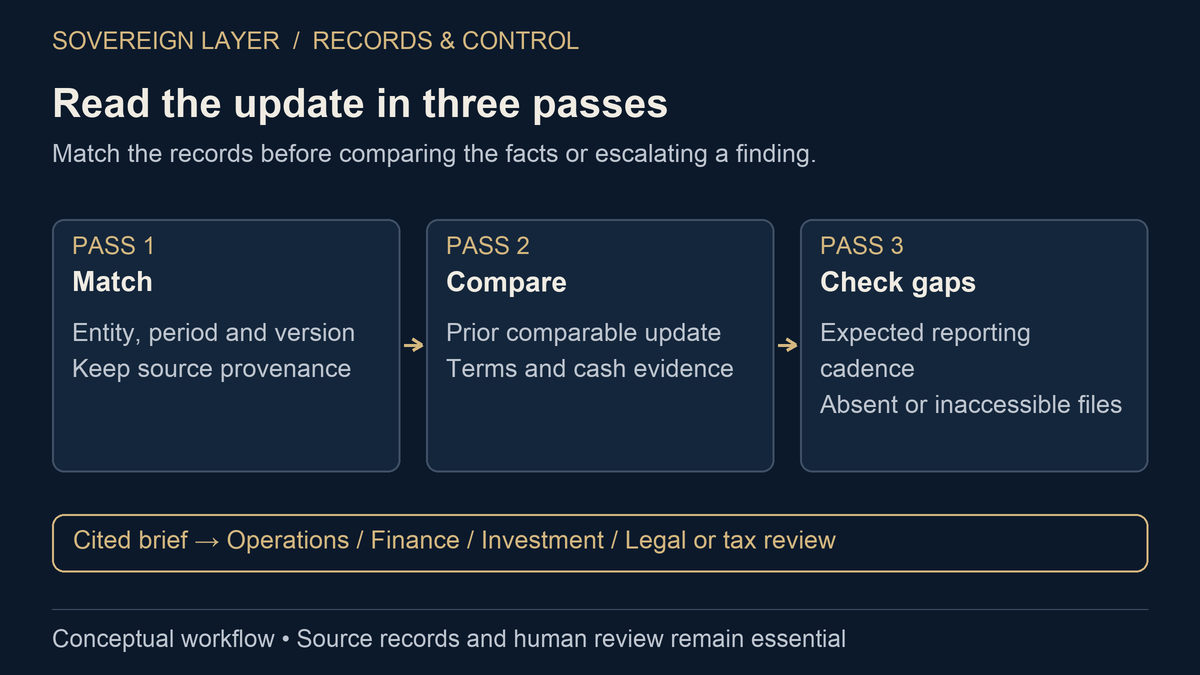
Pass 1: Confirm the Entity, Period and Source
- Identify the issuer and investment. Resolve legal names and aliases before grouping files.
- Identify the investor entity. The family may hold related positions through different trusts, partnerships, or accounts.
- Confirm the period. Separate period end, publication date, receipt date, and any effective date.
- Confirm the document type and version. Mark drafts, amended statements, and restatements plainly.
- Preserve provenance. Record whether the file came from a portal, manager email, adviser, or internal upload.
Entity and period matching should produce a reviewable match, not a silent merge. Low-confidence matches belong in an exception queue.
Pass 2: Ask What Changed
Compare the current update with the most recent comparable period and the records that define the relationship. Focus the review on changed claims, not every repeated paragraph.
| Area | Question | Records to compare |
|---|---|---|
| Valuation | Did reported value change, and did the basis or currency change too? | Current and prior statements, valuation policy, transaction notices |
| Cash activity | Were calls, distributions, fees, or repayments reported? | Notices, bank confirmations, cash ledger, capital-account statements |
| Operating narrative | Did management change guidance, milestones, risks, or timing? | Current and prior letters, board materials where authorized |
| Terms and obligations | Did an amendment or notice change what the investor must do? | Executed agreement, amendments, side letters, notices |
| Contacts and control | Did key personnel, auditor, administrator, or reporting channels change? | Update letter, directory, prior correspondence |
A changed number deserves context. A valuation move may reflect performance, a financing event, currency, methodology, or a corrected prior statement. The reviewer decides which explanation is supported.
Pass 3: Ask What Is Missing
Missing-document monitoring requires an expectation. The office needs to know which updates should arrive, at what cadence, for which investment and entity.
- No current report has arrived for an expected period.
- A report refers to an attachment, schedule, or amendment that is absent.
- A capital-account statement shows activity without the related notice or bank evidence.
- A changed risk or obligation appears without the underlying agreement or board material.
- The file exists, but access restrictions prevent the assigned reviewer from opening it.
Canoe's official documentation describes document-receipt dashboards and flags for missing or delayed alternative-investment documents. That supports the collection job. See Canoe Connect. A family office still needs its own escalation rules and a way to connect the missing item to the decision it affects.
Route the Finding to the Right Person
Not every change is an alert. Give each finding an owner and a reason for review:
- Operations: document identity, receipt, version, and filing exceptions.
- Finance or accounting: cash activity, ledger reconciliation, and reporting treatment.
- Investment team: operating changes, valuation context, portfolio implications, and manager follow-up.
- Legal or tax adviser: agreement interpretation, amendments, tax positions, and compliance questions.
AI can prepare a brief with citations, conflicts, and missing-evidence notes. Human reviewers decide significance and action. The AI governance guide for family offices offers a practical approval matrix.
Illustrative Review Brief
Illustrative example, not client data: A Q2 update for North Harbor Fund IV arrives on August 12. The archive matches the manager, fund, investor entity, and June 30 period. Compared with Q1, the letter reports a revised exit timeline and the capital-account statement shows a contribution.
The review brief cites both documents, notes that no capital-call notice or bank confirmation was found, and routes the missing-evidence question to operations and finance. The investment team reviews the timeline change. The system does not label the investment impaired or recommend a trade.
Use the family-office record questions to define the expected answer, then review the broader storage and extraction choices in the document-management comparison.
Common questions
Can AI monitor private investments for a family office?
AI can help match documents, compare statements, identify missing expected records, and prepare cited briefs. Portfolio calculations and investment decisions should remain in the appropriate systems and with qualified people.
Does a missing update mean an investment is in trouble?
No. It means the expected record was not found in the sources checked. The cause may be timing, delivery, filing, access, or manager delay, so a person should verify it before drawing a conclusion.
Sources and further reading
Sovereign Layer develops private AI for family offices. Will Scott designed the approach around firsthand investment experience and the need to keep private records under client control. Comparisons explain fit by task; they are not independent product rankings.
Book a Private Demo
Choose one investment and one reporting cycle. We can map the expected records, comparison rules, exceptions, and human review path.
Book a Private Demo