

Questions Your Family Office Should Be Able to Answer From Its Records
A usable archive should answer operating questions with source records attached. These eight questions expose gaps that a folder count will not.
What questions should a family office be able to answer from its records?
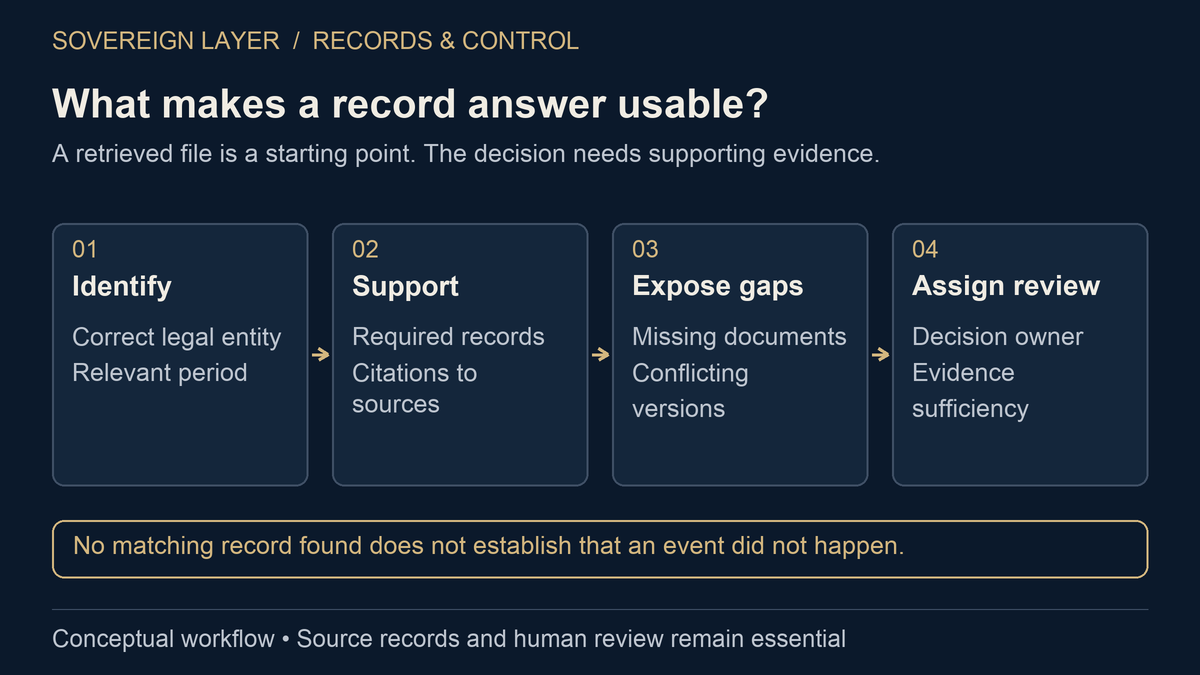
A family office should be able to answer questions about commitments, agreements, funding evidence, missing updates, changed facts, obligations, ownership, and document completeness from its own records. Each answer should identify the entity and period, cite the required documents, show what is missing, and name the person responsible for review.
A Search Result Is Not Yet an Answer
Finding a PDF is progress. An operating answer requires more: the correct entity, the relevant period, supporting records, known gaps, and a reviewer who understands the decision.
The questions below reflect the records a family office needs to review: agreements that take too long to find, changing commitments, missing updates, cash-planning needs and investment facts that become clear too late. The linked example uses fictional records to show how an answer connects to its sources.
Use the list as an archive test. For each question, record whether the answer is complete, which source is controlling, and who can approve action.
1. When Was the Last Capital Call, and How Much Was It?
Required record set: the capital-call notice, the governing agreement, the funding or wire confirmation, and the internal cash ledger. The notice supplies the requested amount and due date. The agreement establishes the commitment terms. The confirmation shows what was actually sent.
Human review: finance should match the legal entity, bank instructions, amount, due date, and settlement evidence. If the notice and wire differ, the system should flag the conflict rather than invent a reconciliation. An illustration using fictional records appears in the cited-answer example.
2. What Does the Agreement Require Us to Do Next?
Required record set: the executed agreement, amendments, side letters, notices, and relevant correspondence. The signed and amended terms matter more than a summary prepared before execution.
Human review: counsel or the responsible adviser should confirm the controlling language and its application. AI can locate clauses and assemble citations. It should not provide an unreviewed legal conclusion. The family-office AI governance guide shows how to assign that approval.
3. How Much of the Commitment Remains Unfunded?
Required record set: the subscription or partnership agreement, every capital-call notice, contribution confirmations, distributions that affect recallable capital, and the accounting system.
Human review: finance should confirm the calculation method and any recallable or recycled amounts. A language model can gather inputs, but the official ledger should own the number used for cash planning.
4. Which Expected Update Has Not Arrived?
Required record set: the manager's reporting schedule, prior statements, portal and inbox receipt history, and an expected-document calendar. A folder alone cannot prove a report is missing unless the office knows what should have arrived. The Canoe and SEI evaluation checklist likewise starts with where reporting documents live and how staff access them.
Human review: operations should confirm the reporting cadence and whether a delayed record was delivered through another channel. The next step may be a manager follow-up, not an investment conclusion.
5. What Changed Since the Previous Update?
Required record set: consecutive reports for the same investment, entity, share class, and reporting period, plus notices issued between periods.
Human review: the investment team should distinguish an economic change from a changed definition, restatement, currency, scope, or reporting date. The private-investment update review provides a practical comparison process.
6. Which Obligations and Deadlines Are Coming Due?
Required record set: agreements, capital-call notices, debt documents, tax correspondence, renewal terms, and the office calendar. Each deadline should retain the source clause or notice that created it.
Human review: the responsible owner should confirm the date, required action, approval path, and escalation. A reminder without a controlling source can create false confidence.
7. Which Entity Owns the Position, and Who Can See It?
Required record set: subscription documents, entity records, ownership schedules, trust documents, account records, and the current permission map.
Human review: legal and operations should confirm ownership and authority. Similar entity names and stale charts are common sources of bad matches. Access should follow the verified structure, not an AI guess. Review the threat and control questions in the private-wealth AI threat model.
8. What Evidence Is Missing From This Answer?
Required record set: the answer's cited documents, the archive inventory, expected-record rules, and source-system logs. The system should show whether it searched the relevant collection and whether any source was unavailable.
Human review: the decision owner should decide whether the evidence is sufficient. “No matching document found” is different from “the event did not happen.” That distinction belongs in every material answer.
Run the Test With One Real Question
Pick one question that took too long last month. Write down the expected sources before searching. Then ask the archive to answer with citations and missing-evidence notes.
If staff cannot open the cited files, the answer is not reviewable. If the source set is incomplete, fix the archive before tuning the prompt. Family Office Document Management Software: Options Compared by Job helps identify whether the gap is storage, extraction, reporting, or record intelligence.
Common questions
Should a family office AI answer financial or legal questions automatically?
It can gather records, identify clauses, compare periods, and cite evidence. A qualified person should review legal, tax, accounting, and investment conclusions before action.
What makes a family office record answer trustworthy?
A trustworthy answer identifies the entity and period, links to the underlying records, states what was not found, and preserves a clear human approval step.
Sources and further reading
Sovereign Layer develops private AI for family offices. Will Scott designed the approach around firsthand investment experience and the need to keep private records under client control. Comparisons explain fit by task; they are not independent product rankings.
Book a Private Demo
Bring one question your staff should be able to answer. We can map the required records, gaps, permissions, and review owner.
Book a Private Demo