

Capital Calls, Commitments and Cash Planning: What AI Can Help a Family Office Track
A capital-call answer depends on more than the notice. The office needs the governing agreement, correct entity, approval, funding evidence, and a clear effect on remaining commitment.
What can AI help a family office track about capital calls and commitments?
AI can help a family office extract capital-call details, find the governing agreement, match the correct investor entity, assemble approval evidence, and reconcile the notice with funding confirmation. It can also organize upcoming cash needs. People should verify instructions, approve transfers, maintain the official ledger, and make legal or investment decisions.
One Capital Call, Several Records
A capital-call notice may state an amount and due date. It does not prove which agreement controls, who approved payment, what was funded, or how much commitment remains.
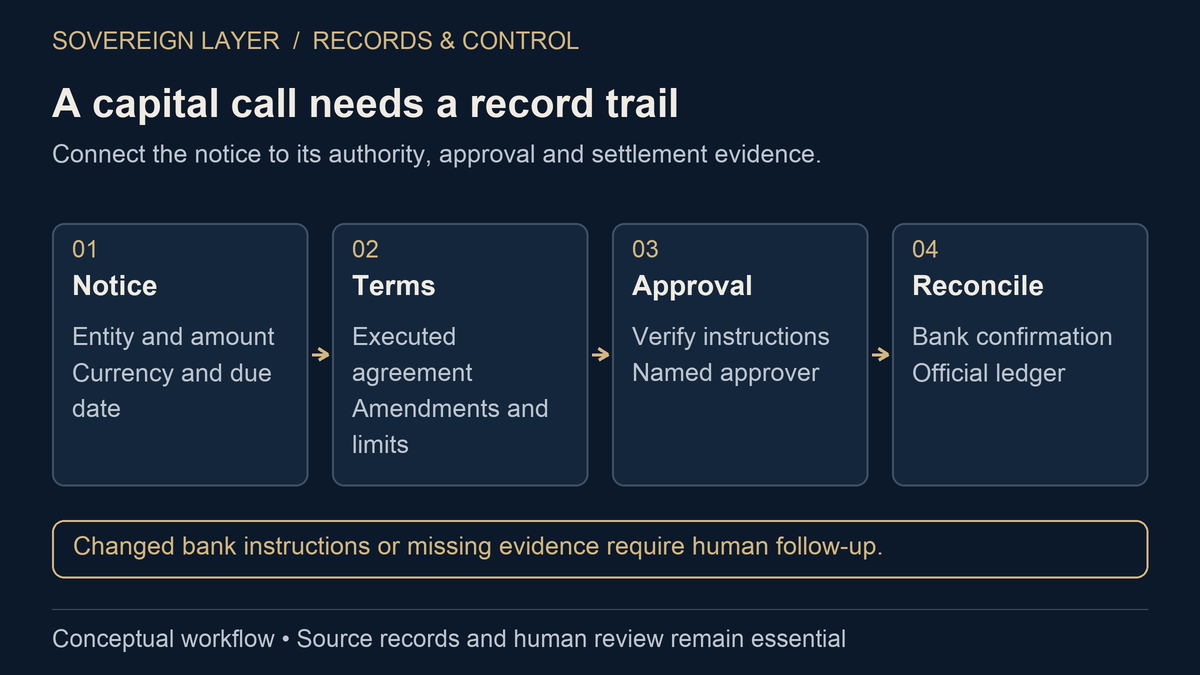
The review set includes the notice, executed agreement, relevant amendments, approval, funding confirmation, and official ledger. The ILPA Capital Call & Distribution Template v2.0 is a reference for standardized notice reporting.
This is operational guidance, not investment, legal, tax, or accounting advice. The example is illustrative and contains no client financial details.
1. Capture the Notice Without Trusting It Blindly
Extract the fund or company, investor entity, call date, due date, requested amount, currency, payment instructions, stated purpose, notice contact, and source location. Keep the original file and its receipt details.
Then run basic checks: Is this the expected sender and portal? Does the investor name match the subscribed entity? Is the notice amended? Do payment instructions differ from prior calls? A changed bank account deserves independent verification through the office's approved process. AI should draw attention to the change, not authorize a transfer.
Canoe describes automated collection and extraction for capital calls and other alternative-investment documents in its official platform overview. A buyer should still verify supported sources, exceptions, and approval controls for the office's own workflow.
2. Match the Governing Agreement
Find the executed partnership, subscription, operating, or investment agreement and every relevant amendment or side letter. Confirm the entity, commitment, call mechanics, notice requirements, deadlines, and exceptions.
AI can retrieve clauses and cite the page. Counsel or the responsible adviser determines what they mean. If the archive contains a draft and executed copy, show the conflict.
A private system helps when agreements sit outside the portfolio platform or use inconsistent names. The redacted cited-answer example shows the source pattern without exposing client files.
3. Route Approval and Protect Confidentiality
Capital-call records contain bank instructions, entity details, signatures, account information, and investment terms. Limit access by role. Separate payment preparation from approval where office controls require it.
The review packet should include the notice, verified instructions, agreement citation, amount, due date, commitment calculation, approval, and exceptions. Log access and changes. Do not paste sensitive instructions into an unapproved consumer AI account.
Use the private-wealth AI threat model to examine data flow and the governance guide to assign approval.
4. Confirm What Was Funded
After payment, match the notice to the wire or bank confirmation and the accounting entry. Record the settlement date, amount, currency, source account, destination, and any fee or variance.
A missing confirmation is a records problem. A different amount is an exception. Neither should be converted into a confident answer. Finance decides whether a variance is timing, fees, partial funding, an amendment, or an error.
Store the notice, approval, and confirmation together without destroying their original locations and provenance. This creates a review trail for the next question.
5. Update Commitment and Cash Planning
The official ledger should calculate remaining commitment according to the agreement and accounting policy. Recallable distributions, recycling, parallel vehicles, or amendments can change the result.
For cash planning, organize calls by due date, entity, currency, funding account, and approval status. Separate confirmed notices, manager guidance, internal estimates, and unknown timing.
AI can assemble the schedule and cite inputs. Treasury and investment staff decide liquidity, transfers, borrowing, or asset sales. No model can promise that a forecast will prevent loss or predict the next call.
Illustrative Capital-Call Review
Illustrative example: Harbor Growth Fund II sends a $240,000 call to Oak Ridge Holdings LLC, due November 12. The archive finds the executed partnership agreement and a prior notice, but the new notice contains different wire instructions.
- Operations records the notice and flags the bank change.
- The system cites the commitment and call terms from the executed agreement.
- Finance independently verifies instructions through an approved contact.
- An authorized person approves the payment.
- The wire confirmation is matched to the notice and ledger entry.
- The official ledger updates remaining commitment after review.
The AI helped assemble evidence and exceptions. It did not approve the wire, interpret the agreement, or decide how to fund the call.
Test the Workflow With Three Questions
- When was the most recent call for this investment, and what was actually funded?
- How much commitment remains, using the office's approved calculation?
- Which confirmed calls are due in the next 30, 60, and 90 days, and what evidence supports each one?
Every answer should name the entity, date, amount, source records, gaps, and reviewer. See all eight family-office record questions, or compare operating models in Build, Buy, or Steward.
Common questions
Can AI calculate a family's remaining commitment?
AI can gather notices, agreement terms, and ledger entries for review. The official accounting or commitment ledger should own the calculation, especially when recallable distributions, recycling, or amendments apply.
Can AI approve a capital-call payment?
It should not replace the office's authorization controls. AI can prepare the review packet and flag changed instructions, while authorized people verify bank details and approve the transfer.
Sources and further reading
Sovereign Layer develops private AI for family offices. Will Scott designed the approach around firsthand investment experience and the need to keep private records under client control. Comparisons explain fit by task; they are not independent product rankings.
Book a Private Demo
Bring one capital-call workflow and the records behind it. We can map the notice, agreement, approval, confirmation, ledger, and privacy controls.
Book a Private Demo